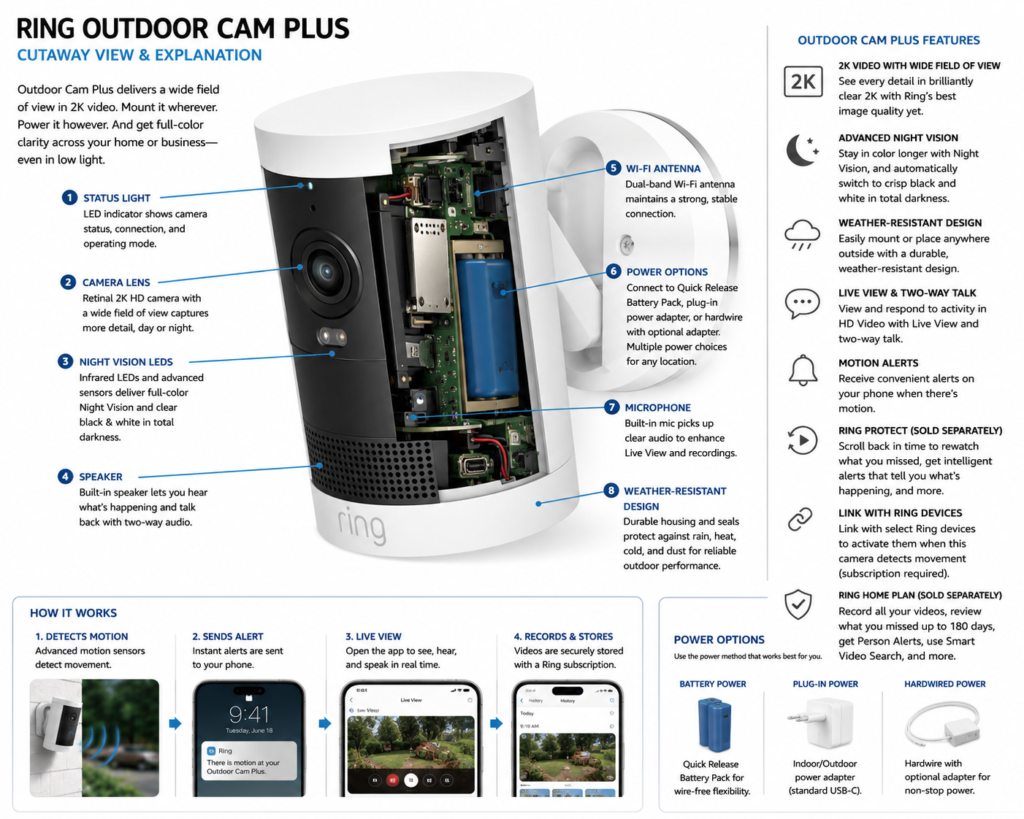
Security cameras have become an important part of modern home and business security.
Whether you’re trying to monitor your front door, driveway, backyard, side entrance, garage, parking area or commercial property, an outdoor security camera can provide an additional layer of awareness and protection.
Modern outdoor cameras can do much more than simply record video.
Depending on the model, today’s cameras can provide:
- High-resolution video
- Wide fields of view
- Color night vision
- Motion detection
- Smartphone alerts
- Live video
- Two-way audio
- Cloud recording
- Intelligent alerts
- Multiple power options
- Integration with other security devices
The cutaway illustration above gives you a closer look at what’s happening inside an outdoor security camera and how the different components work together.
What Is an Outdoor Security Camera?
An outdoor security camera is a surveillance camera designed to monitor areas outside a home or business.
Unlike indoor cameras, outdoor models are designed to handle environmental conditions such as:
- Rain
- Humidity
- Heat
- Dust
- Temperature changes
- Direct sunlight
A properly installed outdoor camera can monitor important areas around a property while sending video and motion notifications to the property owner’s phone.
Some cameras operate entirely through Wi-Fi, while others may use wired network or power connections.
How Does an Outdoor Security Camera Work?
The basic process is surprisingly simple.
1. The Camera Detects Activity
Sensors monitor the area around the camera.
When movement is detected, the camera can begin processing the event.
Depending on the camera, motion detection may use different technologies and algorithms to determine whether something is moving within the camera’s field of view.
2. The Camera Captures Video
The camera’s image sensor and lens capture what’s happening in front of the camera.
Higher-resolution cameras can capture more detail, which can be particularly useful when trying to see:
- Faces
- Vehicles
- Packages
- Clothing
- License plates
- Activity around entrances
The camera shown in the cutaway illustration uses 2K video and a wide field of view.
Higher resolution does not automatically guarantee better security, however. Lighting, camera placement, lens quality, compression and viewing angle all affect the usefulness of recorded video.
3. The Camera Processes the Image
Inside the camera is an electronic processing system that converts the image sensor’s information into usable digital video.
The internal electronics can also handle functions such as:
- Motion detection
- Video compression
- Night vision
- Network communication
- Audio
- Alerts
This is the “brain” of the camera.
Understanding the Outdoor Camera Cutaway
Let’s take a closer look at the components shown in the illustration.
1. Camera Lens
The lens is one of the most important parts of the entire camera.
It determines how much of the scene the camera can see and helps focus light onto the image sensor.
A wide-angle lens allows the camera to monitor a larger area.
For example, positioning a camera near a front door with an appropriate field of view can allow you to monitor both the entrance and surrounding areas.
However, there is a tradeoff.
A wider field of view can cover more area but may make distant objects appear smaller.
That’s why camera placement is just as important as camera resolution.
2. Image Sensor
Behind the lens is the image sensor.
The sensor converts incoming light into an electronic signal that can be processed into video.
The sensor plays an important role in image quality, particularly in challenging lighting.
A good outdoor security camera should be able to produce useful video during:
Bright daylight → low light → nighttime
This is particularly important for entrances and exterior areas where lighting conditions can change throughout the day.
3. Night Vision System
One of the biggest challenges for outdoor security cameras is nighttime.
A camera that looks excellent during the day may produce very different results when there is little or no visible light.
Night vision technology helps address this problem.
Depending on the camera, night vision can use infrared illumination and image processing to provide usable footage when lighting is low.
The Outdoor Cam Plus shown in the illustration supports color night vision in low-light conditions and can switch to black-and-white night vision in darker conditions.
Color Night Vision vs. Black-and-White Night Vision
Color can provide useful information.
For example:
Was the vehicle red, white or black?
What color shirt was the person wearing?
However, color requires sufficient light.
When there isn’t enough available light, cameras may switch to infrared-assisted black-and-white video.
This allows the camera to continue providing usable surveillance footage even when the environment is extremely dark.
4. Wi-Fi and Network Components
Modern outdoor security cameras often connect to the internet through Wi-Fi.
The camera’s internal wireless components allow it to communicate with the homeowner’s network and associated mobile application.
This enables features such as:
- Live View
- Motion notifications
- Cloud recording
- Remote monitoring
- Device management
The quality of the Wi-Fi connection can have a major impact on performance.
A camera installed at the far end of a large property may experience a weaker signal than one installed close to the router or wireless access point.
5. Microphone
Many modern security cameras include a built-in microphone.
The microphone allows the camera to capture audio along with video.
Depending on the model and application, audio can make security footage more useful by providing additional context about what happened.
6. Speaker
The speaker enables two-way communication on compatible cameras.
For example, if someone approaches your front door, you may be able to open the camera’s Live View and communicate with that person through the camera.
This can be useful for:
- Delivery drivers
- Visitors
- Contractors
- Employees
- Customers
- Suspicious activity
You can potentially communicate with someone at your property without physically opening the door.
7. Power System
Outdoor security cameras need a reliable source of power.
Depending on the model, power options can include:
Battery
Battery-powered cameras provide flexible installation because they don’t require a permanent power cable.
The tradeoff is that the battery eventually needs to be recharged or replaced.
Plug-In
A plug-in camera provides continuous power but requires access to an appropriate electrical outlet.
Hardwired
A hardwired installation can provide continuous power without regularly changing or recharging a battery.
This can be an attractive option for permanent installations.
Always follow the manufacturer’s installation requirements and applicable electrical codes when installing powered equipment.
8. Weather-Resistant Housing
An outdoor camera needs protection from the elements.
The housing helps protect the internal electronics from environmental exposure.
Outdoor-rated cameras are designed for exterior environments, but installation location still matters.
For example, mounting a camera underneath an eave can provide additional protection from direct rain and sunlight.
Proper positioning can also improve image quality by reducing glare and water droplets on the lens.
What Does 2K Security Camera Resolution Mean?
Resolution describes how much image detail the camera can capture.
A 2K camera provides substantially more image detail than many older low-resolution surveillance cameras.
This can make it easier to identify important details in recorded footage.
But resolution isn’t everything.
A camera with excellent resolution can still produce poor footage if:
- The lens is dirty.
- The camera is pointed toward direct sunlight.
- The subject is too far away.
- The camera is installed too high.
- The scene is too dark.
- The network connection causes excessive video compression.
Camera placement is critical.
Motion Detection and Security Alerts
One of the most useful features of a modern outdoor security camera is motion detection.
Instead of requiring the property owner to constantly watch a live video feed, the camera can monitor the area automatically.
When activity is detected, the system can send an alert to your phone.
For example:
Person approaches driveway → camera detects movement → phone receives notification → homeowner opens Live View.
This allows the homeowner to respond to activity without continuously monitoring the camera.
Intelligent Security Alerts
Some modern camera systems offer more advanced alerts that attempt to distinguish between different types of activity.
Depending on the camera and subscription plan, features may include person detection or other intelligent event classification.
This can help reduce the number of irrelevant notifications.
For example, you may care more about a person approaching your front door than a tree moving in the wind.
Live View: See What’s Happening Right Now
Live View allows you to open the camera from a compatible mobile application and see what’s happening in real time.
This can be useful when:
- Someone rings the doorbell
- A package is delivered
- You receive a motion alert
- You hear something outside
- An employee arrives
- Someone approaches a gate
- You want to check the property while away
Combined with two-way audio, Live View can provide both visual and audio communication.
Cloud Video Recording
Some security cameras can store recorded video in the cloud.
This means the footage can remain accessible even if someone damages or removes the physical camera.
Cloud storage also makes it easier to review previous events from a mobile application.
Subscription features vary between manufacturers and plans.
Some systems provide basic functionality without a subscription, while advanced features such as extended video history, intelligent alerts and video search may require a paid plan.
Always check the current manufacturer’s subscription terms before purchasing a camera.
How Long Should Security Camera Footage Be Stored?
There isn’t one answer that works for every property.
A homeowner may only need a short recording history.
A business may want significantly longer retention.
Consider how quickly you would need to discover an incident.
For example:
Monday: Package disappears
Tuesday: You notice it
Wednesday: You realize you need the footage
If your system automatically deleted the video after 24 hours, the recording could already be gone.
That’s why businesses and property managers should think carefully about their required retention period.
Where Should You Install an Outdoor Security Camera?
Camera placement is one of the most important decisions.
Common locations include:
Front Door
One of the most important locations because it monitors visitors and package deliveries.
Driveway
A driveway camera can monitor vehicles and people approaching the property.
Side Entrance
Side doors are often less visible from the street and can benefit from additional surveillance.
Backyard
A camera can monitor access to the backyard, pool area or other exterior spaces.
Garage
A camera can monitor vehicles and access around the garage.
Gate
Outdoor cameras can monitor people and vehicles approaching a gate.
Commercial Entrances
Businesses can monitor customer entrances, employee entrances and other important access points.
Don’t Mount the Camera Too High
A common mistake is mounting an exterior security camera too high.
While a high position can make the camera more difficult to reach, it can also reduce the quality of identifying information.
A camera pointed down from a very high position may capture the top of someone’s head rather than a useful facial view.
The ideal mounting height depends on the camera, property and objective.
The goal is to balance:
Security + coverage + image quality + physical protection.
Protecting the Camera From Tampering
An outdoor security camera should be positioned so that it is difficult to tamper with.
Consider:
- Mounting location
- Camera height
- Cable protection
- Access to power
- Visibility
- Lighting
- Nearby structures
A camera should be difficult to reach but still positioned to capture useful footage.
Security Cameras and Door Locks Work Together
A camera doesn’t replace a good lock.
Likewise, a strong lock doesn’t tell you what’s happening outside your property.
These technologies solve different problems.
A lock controls access.
A security camera provides visibility.
Together they can create a stronger overall security strategy.
For example:
Camera detects person → homeowner receives alert → homeowner views Live View → homeowner communicates with visitor → properly secured door prevents unauthorized entry.
This is one reason it’s useful to think about the entire property security system, rather than a single product.
Security Cameras for Businesses
Commercial properties can benefit significantly from exterior surveillance.
Businesses may use cameras to monitor:
- Front entrances
- Employee entrances
- Parking areas
- Loading zones
- Gates
- Storage areas
- Construction areas
- Equipment
- Customer areas
A properly designed camera system can provide valuable information when an incident occurs.
For businesses, however, cameras should be part of a larger security plan that may include:
- Commercial-grade locks
- Access control
- Key control
- Alarm systems
- Security lighting
- Reinforced doors
- Surveillance cameras
Outdoor Security Cameras in South Florida
Outdoor cameras can be especially useful for homes and businesses in South Florida.
Properties throughout Broward and Palm Beach Counties often have multiple exterior access points, including:
- Front doors
- Side doors
- Garages
- Driveways
- Pool areas
- Backyard gates
- Commercial entrances
Weather conditions should also be considered when selecting and installing exterior security equipment.
A camera intended for outdoor use should be installed according to the manufacturer’s requirements and positioned appropriately for the local environment.
Do You Need Professional Security Camera Installation?
Some cameras are designed for homeowners to install themselves.
However, professional installation can make sense when you need:
- Multiple cameras
- Difficult mounting locations
- Long cable runs
- Hardwired power
- Multiple Wi-Fi access points
- Commercial surveillance
- Integration with existing security hardware
- Better camera positioning
- Protection of wiring and equipment
A professional can also help identify areas that may be missed by a homeowner simply mounting a camera where it looks convenient.
Security Camera Installation vs. DIY
| DIY Installation | Professional Installation |
|---|---|
| Lower upfront labor cost | Professional setup |
| Good for simple locations | Better for complex installations |
| Homeowner chooses placement | Professional evaluates coverage |
| Limited electrical/network work | Can coordinate appropriate wiring |
| Suitable for simple systems | Better for larger systems |
| Homeowner handles troubleshooting | Professional support available |
For a single camera in an easy-to-access location, DIY installation may be perfectly reasonable.
For a multi-camera residential or commercial system, professional planning can provide a significant advantage.
What Should You Look for in an Outdoor Security Camera?
Before purchasing a camera, consider these features:
Resolution
Look for enough resolution to capture useful detail at the distances you need.
Field of View
Determine how much of the property you want to see.
Night Vision
Make sure the camera can produce useful footage in your property’s nighttime lighting conditions.
Motion Detection
Look for motion detection that suits the environment.
Two-Way Audio
Useful when you want to communicate with people near the camera.
Weather Resistance
Verify that the camera is actually designed for outdoor use.
Power
Choose between battery, plug-in or hardwired options based on the installation location.
Storage
Understand whether video is stored locally, in the cloud or through another system.
Subscription
Check which features require an ongoing subscription.
Network Connectivity
Make sure the camera can maintain a reliable connection from its installation location.
Ring Outdoor Cam Plus
The camera shown in the cutaway illustration is the Ring Outdoor Cam Plus.
Its feature set includes:
- 2K video
- Wide field of view
- Color night vision in suitable low-light conditions
- Black-and-white night vision in darkness
- Live View
- Motion alerts
- Two-way communication
- Weather-resistant construction
- Multiple power options
- Integration with compatible Ring devices
- Optional subscription features
Some advanced recording and intelligent features require a compatible Ring subscription or Ring Home Plan.
Because manufacturers can change hardware, software and subscription features, always check the current specifications before purchasing.
A Camera Is Only One Part of Your Security
This is perhaps the most important takeaway.
Installing a security camera doesn’t automatically make a property secure.
Think about security as layers.
Layer 1 — Physical Security
- Strong doors
- Quality deadbolts
- Reinforced frames
- Secure windows
- Proper strike plates
Layer 2 — Access Control
- Rekeying
- Restricted keys
- Keypad locks
- Smart locks
- Commercial access control
Layer 3 — Detection
- Security cameras
- Motion sensors
- Door sensors
- Alarm systems
Layer 4 — Response
- Mobile alerts
- Live View
- Two-way communication
- Security monitoring
- Emergency response procedures
The more thoughtfully these layers work together, the more useful your overall security system becomes.
Fine Locksmith USA Can Help With Your Property Security
Fine Locksmith USA specializes in residential and commercial locksmith services throughout Broward and Palm Beach Counties.
If you’re upgrading the security of your home or business, we can help with the physical security side of the equation, including:
- Deadbolt installation
- High-security locks
- Rekeying
- Commercial locks
- Keypad locks
- Smart locks
- Access control
- Master key systems
- Lock repair
- Security upgrades
A security camera gives you visibility.
A properly installed lock helps control access.
You need both to build a more complete security strategy.
Need help securing your home or business?
Call Fine Locksmith USA at (954) 420-7121.
Learn More About Our Locksmith Services
Frequently Asked Questions
Are outdoor security cameras worth it?
For many homeowners and businesses, outdoor cameras provide useful visibility around entrances, driveways, gates and other exterior areas. Their value depends on proper placement, reliable power/network connectivity and appropriate recording features.
Do outdoor security cameras work at night?
Yes. Many outdoor security cameras use infrared or other low-light technologies to provide nighttime video. Some models can provide color imagery in low-light conditions and switch to black-and-white when the environment becomes darker.
Do security cameras need Wi-Fi?
Not necessarily. Many consumer cameras use Wi-Fi, but other surveillance systems can use wired Ethernet or other network configurations.
Do outdoor cameras need electricity?
Yes, cameras need power, but the source varies. Depending on the model, this can include batteries, plug-in power or hardwired power.
Can security cameras record without Wi-Fi?
This depends on the camera and its storage system. Some cameras rely heavily on network connectivity and cloud services, while other surveillance systems can record locally.
How high should an outdoor security camera be mounted?
There is no universal height. The camera should be high enough to discourage tampering while still providing a useful viewing angle. The ideal position depends on the property, camera lens and surveillance objective.
Can security cameras replace an alarm system?
No. Cameras and alarm systems serve different purposes. A camera provides visual information, while an alarm system can detect events and trigger an alert or monitoring response.
Should I install security cameras or upgrade my locks first?
For many properties, both are valuable. Locks help prevent unauthorized physical access, while cameras provide visibility and evidence of activity. If your doors currently have damaged, weak or outdated locks, addressing physical security should be a priority.
Final Thoughts
Modern outdoor security cameras have evolved far beyond simple video recording.
A single camera can combine:
2K video + wide-angle coverage + night vision + motion detection + smartphone alerts + Live View + two-way audio.
But technology alone isn’t enough.
The camera needs to be installed in the right location, connected reliably, powered appropriately and integrated into a broader security strategy.
For the best results, think about your property as a whole.
Secure the doors. Control access. Monitor important areas. Detect suspicious activity. And make sure you have a plan for responding to alerts.
If you’re located in Broward or Palm Beach County and you’re upgrading your property’s physical security, Fine Locksmith USA can help you evaluate your locks, doors and access points.
Fine Locksmith USA
Residential & Commercial Locksmith Services
Broward & Palm Beach County
(954) 420-7121