No batteries. No charging. No smartphone app. No Wi-Fi. Just a mechanical code and a locking mechanism.
Mechanical keyless door locks offer a simple alternative to traditional keyed locks and electronic smart locks. Instead of inserting a key or relying on batteries and electronics, the user enters a combination using mechanical push buttons and then operates the door handle.
The result is a straightforward keyless entry system that can be useful for homes, businesses, gates, garages, storage areas and other locations where convenient controlled access is needed.
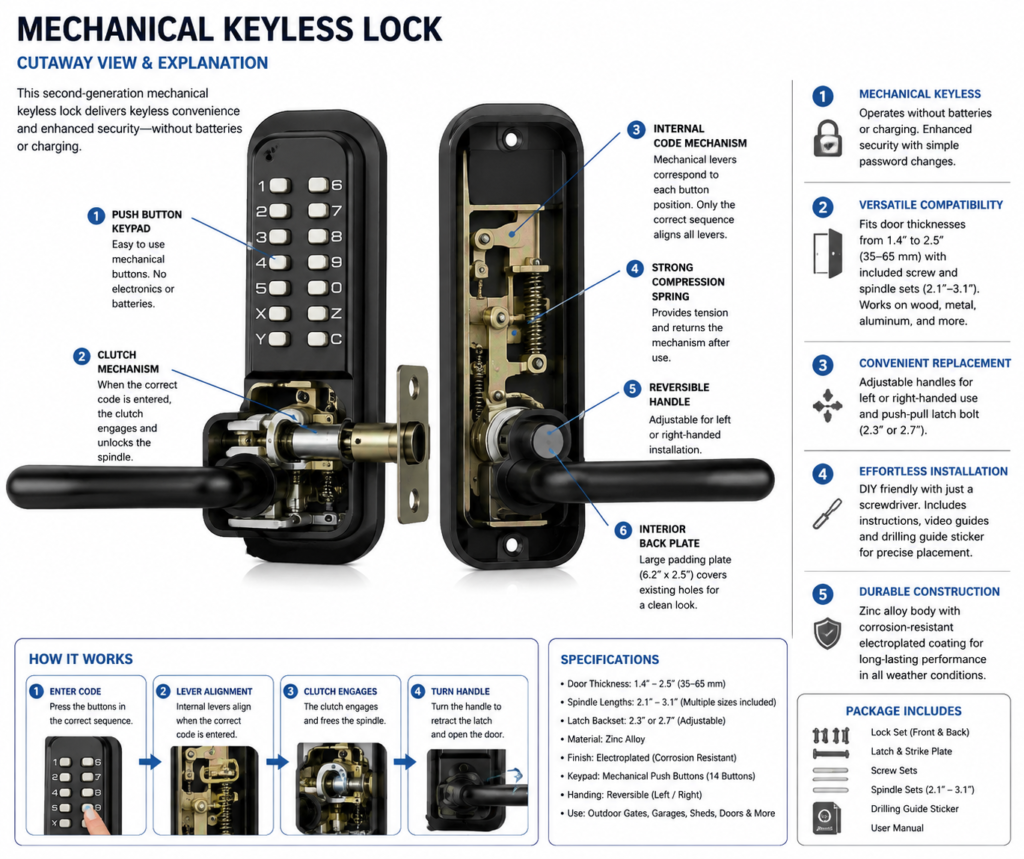
The cutaway illustration above shows what is happening inside a mechanical keyless lock when the correct code is entered.
What Is a Mechanical Keyless Door Lock?
A mechanical keyless door lock is a locking system that uses a mechanical combination instead of a traditional key.
Unlike an electronic smart lock, a fully mechanical lock does not depend on:
- Batteries
- Electrical wiring
- Wi-Fi
- Bluetooth
- Smartphone applications
- Charging
The buttons on the outside of the lock operate internal mechanical components. When the correct combination is entered, those components align and allow the handle mechanism to operate the latch.
Mechanical push-button locks are commonly used where simple access control and low maintenance are important. Current mechanical keyless products on the market are available for applications ranging from exterior gates and garages to commercial and residential doors.
How Does a Mechanical Keyless Lock Work?
The easiest way to understand the lock is to follow the process from the keypad to the latch.
Step 1: Enter the Code
The user presses the designated buttons on the keypad in the correct combination.
Unlike an electronic keypad, these buttons physically move internal components.
There is no electronic signal being transmitted.
Step 2: The Internal Mechanism Aligns
Behind the keypad is a series of mechanical levers, pins, springs and other components.
When the correct buttons are pressed, the corresponding internal components move into their designated positions.
If the wrong combination is entered, the mechanism does not reach the correct configuration and the handle remains unable to operate the latch.
This is the fundamental principle behind a mechanical combination lock.
Step 3: The Clutch Engages
One of the most important components is the clutch mechanism.
The clutch separates the outside handle from the latch mechanism when the lock is secured.
After the correct combination has been entered, the clutch engages.
This allows movement of the outside handle to be transferred to the spindle and latch.
In simple terms:
Wrong code → clutch remains disengaged → handle cannot retract the latch.
Correct code → clutch engages → handle can operate the latch.
Step 4: Turn the Handle
Once the mechanism has been correctly aligned, the user turns the lever.
The handle rotates the internal spindle and operates the latch bolt.
The latch retracts, allowing the door to open.
It’s a completely mechanical chain of events:
Push buttons → internal levers → clutch → spindle → latch → door opens
Cutaway Explanation: What’s Inside the Lock?
The cutaway view makes it easier to understand the different components.
1. Push-Button Keypad
The keypad is the part of the lock the user interacts with.
Instead of a keyway, the exterior side contains mechanical buttons.
The buttons are connected to internal components that determine whether the correct combination has been entered.
One advantage of this design is that the keypad doesn’t require electrical power.
2. Clutch Mechanism
The clutch is essentially the connection between the outside handle and the locking mechanism.
When the lock is secured, the outside handle cannot simply retract the latch.
Entering the correct combination causes the internal mechanism to engage the clutch.
The handle can then operate the latch.
This is one of the most important components shown in the cutaway.
3. Internal Code Mechanism
Behind the keypad is the mechanical “brain” of the lock.
Rather than a circuit board processing a PIN, physical components respond to the buttons being pressed.
Different button combinations move different internal elements.
Once the correct combination has been established, the mechanism permits the handle to operate.
This is why mechanical keyless locks can continue functioning without batteries or electronic components.
4. Springs and Return Mechanism
Springs inside the lock provide tension and help return mechanical components to their proper positions after operation.
These springs are an important part of maintaining consistent operation of the buttons, clutch and latch mechanism.
The exact internal construction varies between manufacturers and lock models, so the cutaway should be viewed as a general illustration of how this type of mechanism works.
5. Reversible Handle
Many mechanical keyless locks are designed so that the handle can be configured for either a left-handed or right-handed door.
This is useful when installing the same lock design on different doors.
Before installation, the lock should be configured according to the direction in which the door opens.
6. Interior Backplate
The large backplate provides the interior mounting surface for the lock.
A larger plate can also help provide a clean finished appearance while covering the mounting area.
The exact dimensions and mounting configuration depend on the specific lock.
The Biggest Advantage: No Batteries
One of the most attractive features of a mechanical keyless lock is its simplicity.
Electronic locks can provide excellent convenience, but they introduce additional components such as batteries, wiring, electronics and software.
A mechanical keyless lock eliminates those requirements.
There is no battery to replace.
There is no charger to plug in.
There is no Wi-Fi connection to configure.
And there is no smartphone application required to operate the mechanical mechanism.
That makes mechanical locks particularly attractive for locations where simplicity and reliability are priorities.
Battery-free mechanical keyless locks are specifically marketed for applications where users want keyless access without battery maintenance.
Mechanical Keyless vs. Electronic Smart Lock
So which type is better?
It depends on what you’re trying to accomplish.
| Feature | Mechanical Keyless Lock | Electronic Smart Lock |
|---|---|---|
| Physical key required | No | Usually no |
| Batteries | No | Usually required |
| Wi-Fi | No | Optional/varies |
| Bluetooth | No | Often available |
| Smartphone | No | Often available |
| Code entry | Yes | Usually |
| Remote access | No | Often available |
| App control | No | Often available |
| Battery maintenance | None | Required |
| Mechanical operation | Yes | Varies |
| Simple installation | Often | Varies |
| Best for simple access | Excellent | Good |
| Best for remote management | No | Yes |
The important distinction: a mechanical keyless lock is designed for simple physical access control, while a smart lock can provide additional digital features such as remote access and app management.
Fine Locksmith USA also installs smart locks for customers who specifically want app control, remote access and other connected features.
Where Are Mechanical Keyless Locks Used?
Mechanical keyless locks can be useful in many different situations.
Residential Doors
A homeowner may want keyless entry without having to maintain batteries or connect the lock to a smart-home system.
It can be particularly convenient for family members who regularly need access.
Gates
Mechanical keyless locks can be especially convenient for gates.
Instead of giving every person a physical key, authorized users can enter the combination.
This can be useful for:
- Backyard gates
- Side gates
- Pool areas
- Property entrances
- Garden gates
Garages
A mechanical keypad lock can provide convenient access to a garage, workshop or storage area without requiring another physical key.
Rental Properties
Property owners and managers may also use keyless mechanical locks where multiple people need access.
However, the owner should have a clear procedure for changing the combination whenever access needs to be removed.
Businesses
Mechanical keyless locks can be useful for certain commercial applications where employees or authorized personnel need access to a specific room or entrance.
Examples include:
- Storage rooms
- Offices
- Utility rooms
- Workshops
- Maintenance areas
- Back entrances
- Small businesses
- Equipment areas
For larger commercial properties, however, a professional locksmith may recommend a more comprehensive access-control or master-key system depending on the number of users and doors.
Fine Locksmith USA provides commercial locksmith services including master-key systems, access control, commercial rekeying and keypad entry.
What Door Thickness Can These Locks Fit?
The particular lock shown in the cutaway example is designed around a relatively broad range of door configurations.
Based on the specifications provided for this model, it can accommodate approximately:
Door thickness:
1.4–2.5 inches (35–65 mm)
It also includes multiple spindle lengths and latch configurations to accommodate different door setups.
However, not every mechanical keyless lock has these dimensions.
Before purchasing or installing a lock, a locksmith should verify:
- Door thickness
- Backset
- Existing bore holes
- Latch size
- Door handing
- Door material
- Frame condition
- Strike location
Getting these measurements right is important for proper operation.
Zinc Alloy Construction and Weather Resistance
Many mechanical keyless locks are constructed from zinc alloy and finished with a protective coating.
The particular model shown is described as having a corrosion-resistant electroplated finish.
That makes this type of hardware suitable for applications where the lock may encounter normal outdoor exposure.
However, weather-resistant does not mean maintenance-free.
Exterior locks should still be installed correctly and maintained according to the manufacturer’s recommendations, particularly in environments with heavy rain, humidity, salt air or corrosive conditions.
Can You Install a Mechanical Keyless Lock Yourself?
Some mechanical keyless locks are designed for relatively straightforward installation.
Depending on the model and existing door preparation, installation may require only basic tools such as a screwdriver.
Some products also include:
- Installation instructions
- Drilling templates
- Hardware
- Multiple spindle lengths
- Multiple screw sets
- Latch and strike hardware
However, there is an important difference between physically mounting a lock and ensuring that it is properly fitted and operating correctly.
A locksmith can verify the door preparation, alignment, latch operation and overall security of the installation.
Why Proper Installation Matters
Even the best lock can perform poorly if it isn’t installed correctly.
A locksmith should check:
Door alignment
The latch should enter the strike cleanly without excessive force.
Strike alignment
The strike should line up correctly with the latch.
Door frame
A weak or damaged frame can compromise the security of the entire door.
Lock mounting
The lock should be securely attached with the appropriate hardware.
Handle operation
The handle should operate smoothly without binding.
Code mechanism
The buttons should operate consistently and the correct combination should reliably engage the mechanism.
Are Mechanical Keyless Locks Secure?
This is an important question.
A mechanical keyless lock can provide convenient controlled access, but it should not automatically be considered more secure than every traditional deadbolt or electronic lock.
Security depends on the specific lock design, installation, door, frame and application.
For example, a high-quality lock installed on a weak door frame may still leave the property vulnerable.
Similarly, a mechanical keypad lock with a code that has been widely shared may not provide the access control the property owner expects.
The correct question isn’t simply:
“Is a keyless lock secure?”
It’s:
“Is this particular lock appropriate for my door and security requirements?”
That’s where a professional locksmith can help.
Mechanical Keyless Locks vs. Traditional Keys
There are several reasons a property owner may prefer a mechanical keyless lock.
No physical key
Users don’t have to carry a key.
No lost-key problem
There is no physical house key to lose.
No battery
The lock doesn’t stop functioning because a battery has died.
Easy shared access
Authorized users can receive the combination rather than a physical key.
Simple operation
Enter the code and operate the handle.
However, there are also tradeoffs.
If too many people know the combination, access control can become difficult.
For that reason, the code should be treated like a key: only provide it to people who actually need access.
Mechanical Keyless Locks for South Florida Properties
South Florida presents some unique considerations for exterior door hardware.
Homes and businesses in Broward and Palm Beach Counties can have exterior gates, garages, storage areas and other access points that need convenient entry.
A mechanical keyless lock can be an option when the property owner wants keyless access without installing an electronic system.
Fine Locksmith USA serves residential and commercial customers throughout Broward and Palm Beach County, including Pompano Beach, Fort Lauderdale, Deerfield Beach, Boca Raton, Coral Springs, West Palm Beach and surrounding communities.
When Should You Call a Locksmith?
Consider professional installation if:
- Your door doesn’t have standard preparation.
- The latch isn’t aligned correctly.
- The existing lock is damaged.
- You’re replacing an older lock.
- You need several doors configured.
- You need a commercial access solution.
- You want multiple doors keyed or controlled together.
- You’re unsure which lock fits your door.
- You want to compare mechanical, electronic and traditional locking systems.
A professional can inspect the opening before recommending a solution.
Mechanical Keyless Lock Installation in South Florida
If you’re considering replacing a traditional lock with a mechanical keyless entry system, Fine Locksmith USA can help you determine what type of locking solution is appropriate for your property.
Fine Locksmith USA provides residential and commercial locksmith services throughout South Florida, including lock installation, rekeying, security upgrades and keyless/smart-lock solutions.
Need a keyless entry lock installed?
Call Fine Locksmith USA today at (954) 420-7121.
Fine Locksmith USA — Locksmith Services
Frequently Asked Questions
Do mechanical keyless locks need batteries?
No. A fully mechanical keyless lock operates through physical buttons, springs, levers and other mechanical components rather than batteries or electronic circuitry.
Can a mechanical keyless lock be used outdoors?
Some models are designed for exterior applications such as gates and garages. Check the manufacturer’s specifications for the specific model, particularly regarding weather and corrosion resistance.
Can the handle be installed on either side?
Many models feature reversible handing, allowing them to be configured for left- or right-handed doors. The specific lock should be checked before installation.
Can I change the combination?
Many modern mechanical keyless locks allow the combination to be changed without replacing the entire lock. The exact procedure varies by model.
Are mechanical keyless locks better than smart locks?
Neither is automatically better. Mechanical locks are excellent when you want simple, battery-free operation. Smart locks are more appropriate when you want features such as remote access, smartphone control or smart-home integration.
Can a locksmith install a keyless lock?
Yes. A locksmith can install many types of mechanical keyless and electronic keyless locks and verify that the lock, latch, door and frame are properly aligned.
Can mechanical keyless locks be used on commercial doors?
Yes, depending on the application and hardware requirements. For larger commercial properties, a locksmith may recommend a more comprehensive access-control or master-key solution.
Final Thoughts
A mechanical keyless door lock takes a surprisingly simple approach to keyless entry.
Instead of relying on batteries, electronics or an app, the lock uses buttons, springs, levers, a clutch and a latch mechanism to control access.
The cutaway view makes the concept easy to understand:
Enter the correct combination → the internal mechanism aligns → the clutch engages → the handle operates the latch → the door opens.
For homeowners, landlords, businesses and property managers who want keyless convenience without battery maintenance, a mechanical keyless lock can be an interesting alternative to both traditional keyed locks and electronic smart locks.
The most important step is choosing the right lock for the door, application and desired level of security.
If you’re not sure which option is right for your property, a professional locksmith can inspect the door and help you compare your choices.
Fine Locksmith USA
Residential • Commercial • Keyless Entry • Security Upgrades
Broward & Palm Beach County
(954) 420-7121